Rerank 4
Captured source
source ↗North Mini Code. Cohere's first model for developers.
Dec 11, 2025
6 minutes read
Introducing Rerank 4: Cohere’s most powerful reranker yet
A milestone in search and retrieval, offering unmatched accuracy and speed for enterprise applications.
_Key Contributors: Clifton Poth (Member of Technical Staff), Fabian David Schmidt (Member of Technical Staff), Martin Hentschel (Member of Technical Staff), Daniel Simig (Manager of Technical Staff), Nils Reimers (VP of Embeddings & Search), Elliott Choi (Director of Product)_
Rerank 4 is the most advanced set of reranker models available today, purpose-built to meet the realities and challenges of enterprise AI search. It delivers best-in-class retrieval, outperforming the likes of MongoDB’s Voyage models and ElasticSearch’s Jina rerankers in overall search relevance, as well as improved latency, flexible deployment options, deep customizability and robust multilingual performance. Designed for business-critical applications across key industries and domains, Rerank 4 sets a new standard for accuracy and adaptability in enterprise search.
##### Why reranking matters
Rerankers significantly enhance the accuracy of enterprise AI search by refining initial retrieval results. After a fast but broad candidate-generation step using methods like BM25 or bi-encoder embeddings, the system is left with documents, passages, or product listings that approximate relevance but often miss the nuance of the user’s intent. Rerank 4 addresses this gap using a cross-encoder architecture that processes queries and candidates jointly, capturing subtle semantic relationships and reordering results to surface the most relevant items. This approach balances speed and accuracy, delivering high-quality results without evaluating the entire corpus.
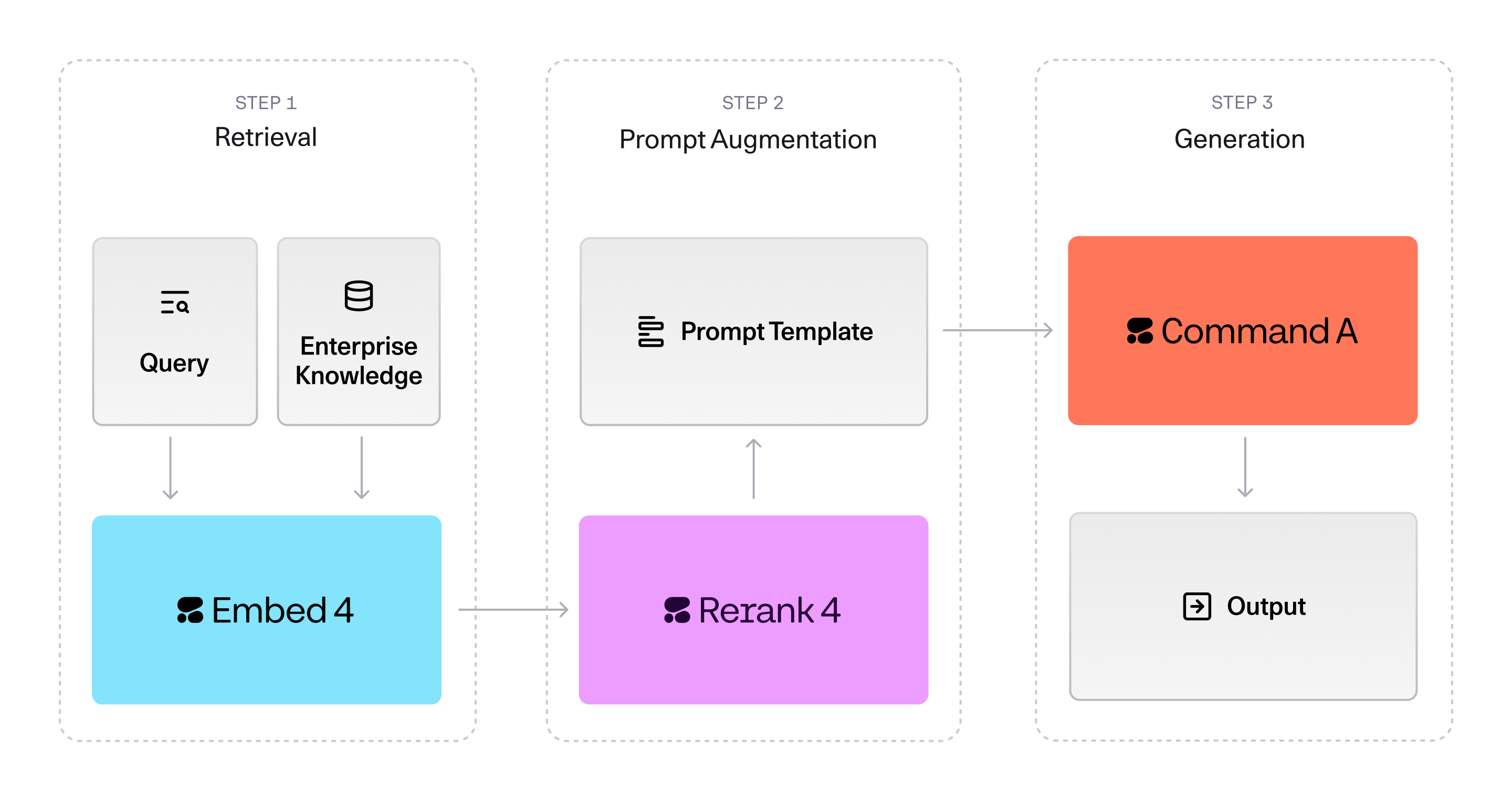
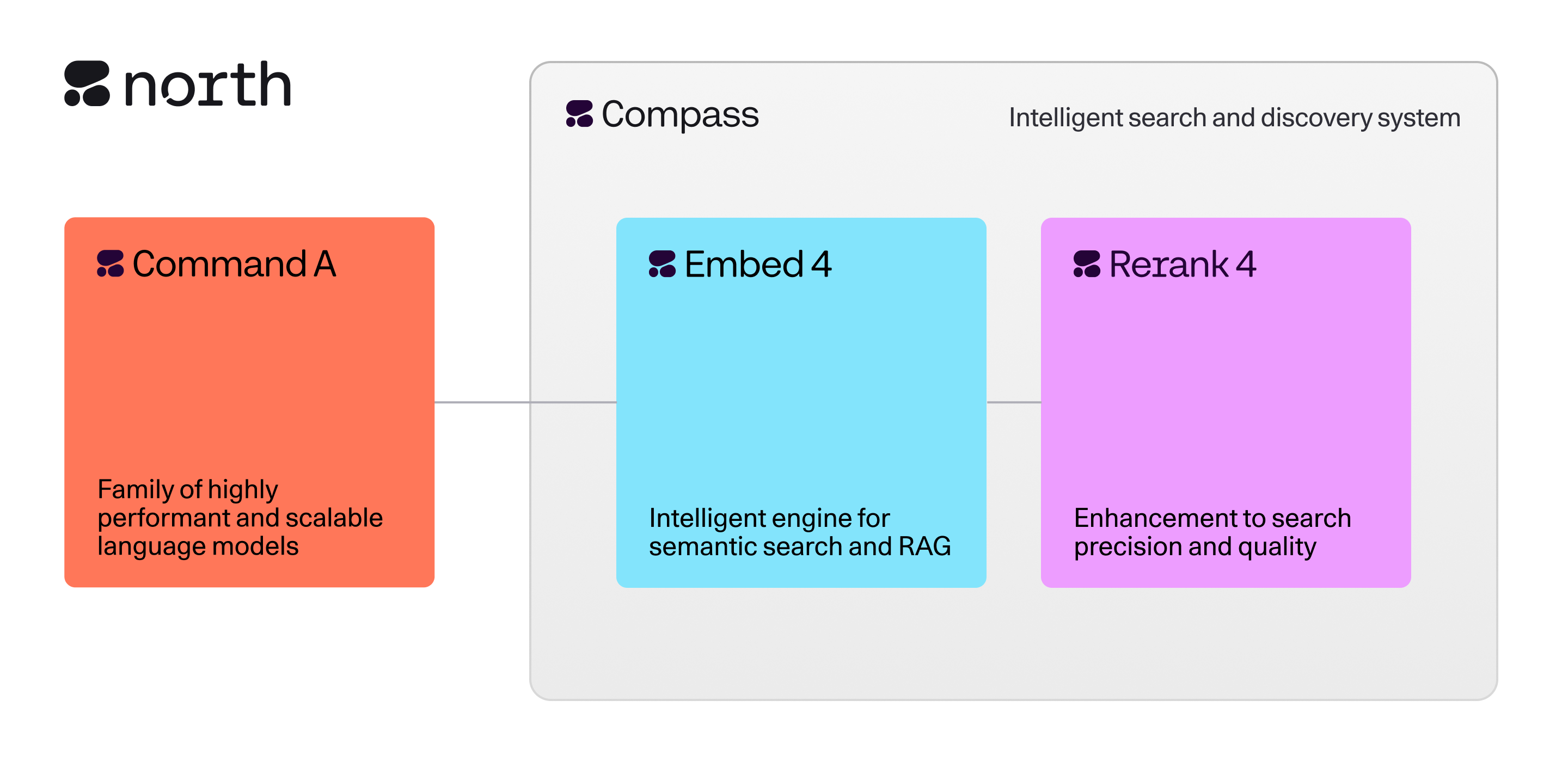
Rerank 4 is a key component of North, Cohere’s agentic AI platform, which combines intelligent search ( Embed, Rerank), large language models (our Command series), and customizable AI agents to automate tasks and accelerate decision-making. It integrates seamlessly into existing AI search solutions, including hybrid, vector, and keyword-based systems, with minimal code changes. Beyond improving retrieval-augmented generation (RAG) pipelines, Rerank 4 is critical in agentic AI systems, providing distilled, high-quality information for stronger reasoning and context-aware agent performance. By filtering out irrelevant content before it reaches the generative model, Rerank 4 reduces token usage and minimizes the number of costly retries an agent might otherwise need to “get it right,” sparing the user both pennies and latency. This is especially impactful for agentic AI, where complex, multi-step interactions can quickly drive up model calls and saturate context windows.
##### Rerank 4 Fast & Pro
Rerank 4 boasts a 32K context window \- the largest of our Rerank series to date and a four-fold increase over the previous generation. This enables the model to handle longer documents, evaluate multiple passages simultaneously, and capture relationships across sections that shorter windows would miss. This expanded capacity therefore improves ranking accuracy for realistic document types and increases confidence in the relevance of retrieved results.
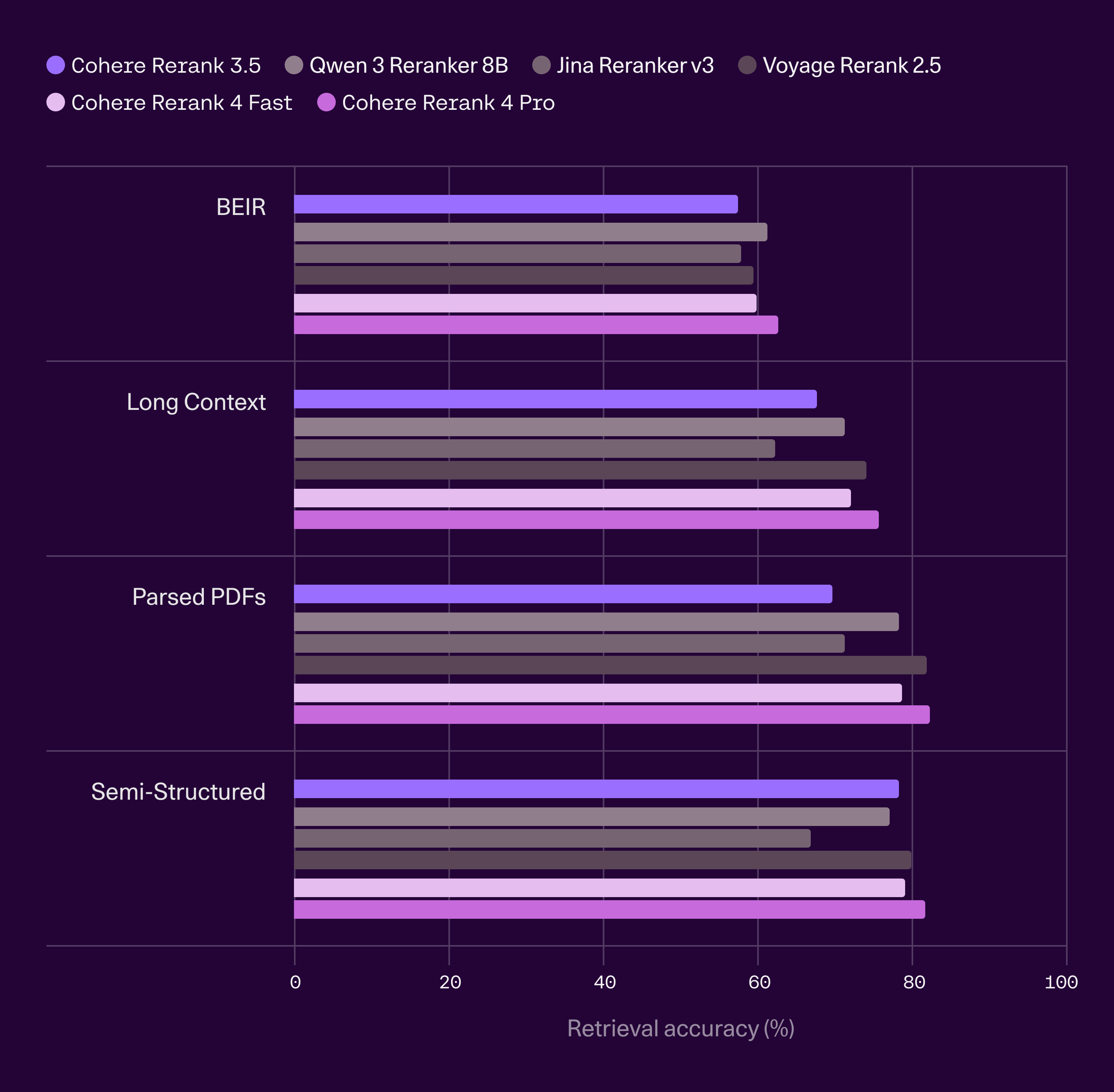_Retrieval performance (nDCG@10) by reranker across public (BEIR) and internal benchmarks. Internal benchmarks are grouped by type of retrieval documents: ‘Long Context’ targets retrieval of documents with several thousand words. ‘Parsed PDFs’ groups retrieval datasets with PDFs parsed across financial, healthcare, biomedical, healthcare domains, spanning 6 languages in total. ‘Semi-Structured’ evaluates retrieval on mixtures of structured data (e.g., metadata of products) and free-form text._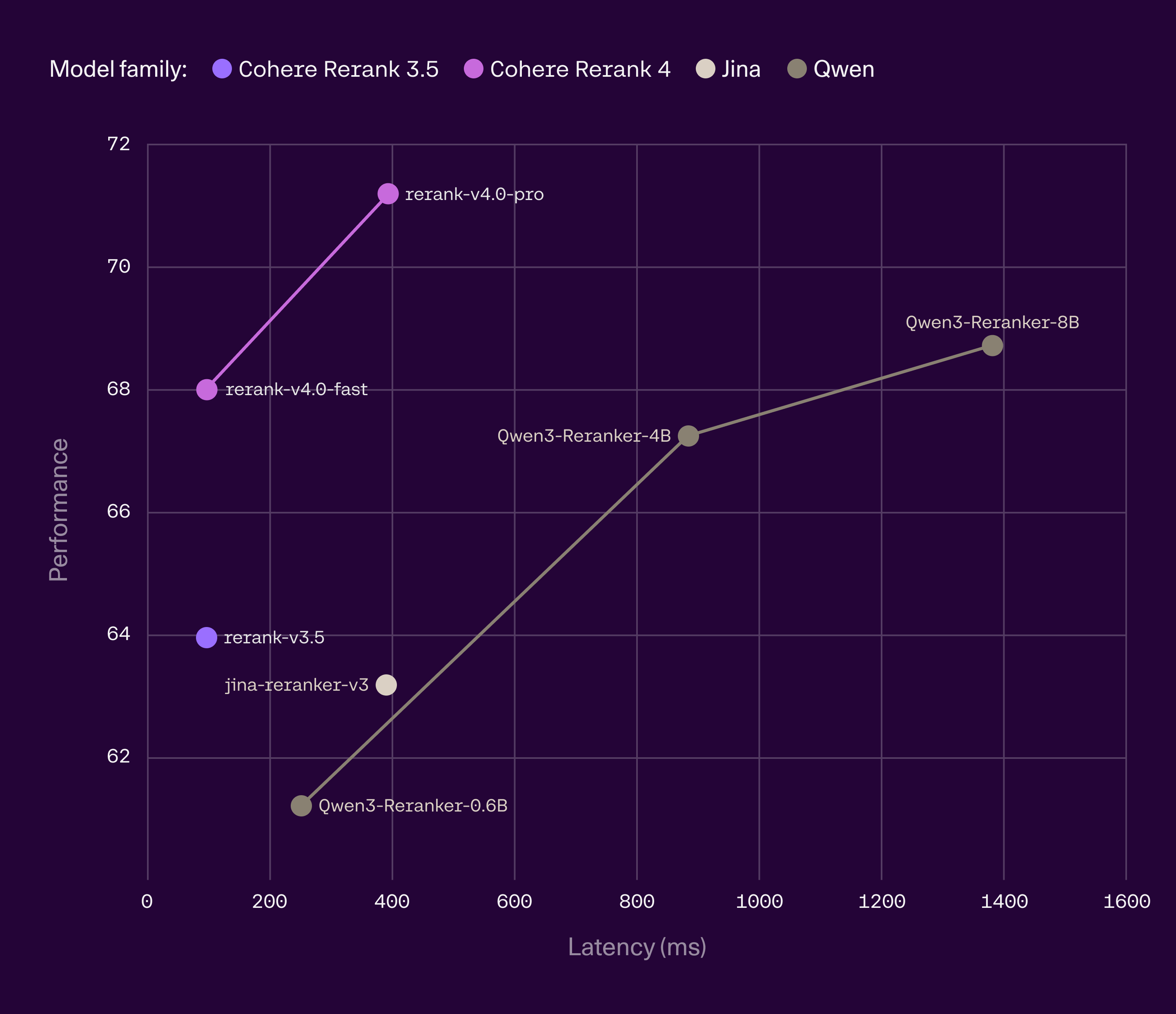_Pareto-efficient frontier of retrieval latency (ms for 30 x 500 tokens; time to process 15,000 tokens) versus average retrieval performance (nDCG@10) by reranker pooled over all benchmarks across languages and domains (cf. Plot 1, Plot 3, Plot 4)_
To support different search workloads, Rerank 4 is available in two versions. Fast is a smaller model designed for use cases where both speed and accuracy are important. Pro, meanwhile, is optimized for tasks that require deeper reasoning, analysis and ironclad precision.
Rerank 4 Fast - where speed wins:
1. _E-commerce._ Prospective customers benefit from high relevance product recommendations as well as the option to explore online catalogues with semantic search. Here, faster results equal a better shopping experience and higher conversion rates. 2. _Programming_. During a project, engineers need to quickly and conveniently reference documentation - like design specs - without derailing their creativity or collaboration. 3. _Customer service_. Enterprise help desk agents need to efficiently triage incoming tickets to resolve cases, prevent backlogs, and keep their customers happy.
Rerank 4 Pro - where depth matters:
1. _Finance._ When generating risk models, analysts rely on troves of market reports, regulatory filings, and transaction histories. More retrieval time means richer data analysis and more accurate scenarios modeled. 2. _Healthcare_. Clinicians routinely review patient records and clinical trial reports to identify appropriate courses of treatment. Accuracy and completeness of information can have devastating consequences for patient welfare. 3. _Manufacturing._ Quality engineers consult technical manuals and production logs to diagnose deviations in highly complex processes that led to product defects. More informed decision-making helps productivity, safety, and end customer...
Excerpt shown — open the source for the full document.
Notability
notability 7.0/10Model update from major AI lab.