QwenLM/qwen-code
TypeScript
Captured source
source ↗QwenLM/qwen-code
Description: An open-source AI coding agent that lives in your terminal.
Language: TypeScript
License: Apache-2.0
Stars: 25088
Forks: 2494
Open issues: 803
Created: 2025-06-26T01:37:46Z
Pushed: 2026-06-11T03:51:50Z
Default branch: main
Fork: no
Archived: no
README:
🎉 News
- 2026-04-15: Qwen OAuth free tier has been discontinued. To continue using Qwen Code, switch to Alibaba Cloud Coding Plan, OpenRouter, Fireworks AI, or bring your own API key. Run
qwen authto configure.
- 2026-04-13: Qwen OAuth free tier policy update: daily quota adjusted to 100 requests/day (from 1,000).
- 2026-04-02: Qwen3.6-Plus is now live! Get an API key from Alibaba Cloud ModelStudio to access it through the OpenAI-compatible API.
- 2026-02-16: Qwen3.5-Plus is now live!
Why Qwen Code?
Qwen Code is an open-source AI agent for the terminal, optimized for Qwen series models. It helps you understand large codebases, automate tedious work, and ship faster.
- Multi-protocol, flexible providers: use OpenAI / Anthropic / Gemini-compatible APIs, Alibaba Cloud Coding Plan, OpenRouter, Fireworks AI, or bring your own API key.
- Open-source, co-evolving: both the framework and the Qwen3-Coder model are open-source—and they ship and evolve together.
- Agentic workflow, feature-rich: rich built-in tools (Skills, SubAgents) for a full agentic workflow and a Claude Code-like experience.
- Terminal-first, IDE-friendly: built for developers who live in the command line, with optional integration for VS Code, Zed, and JetBrains IDEs.
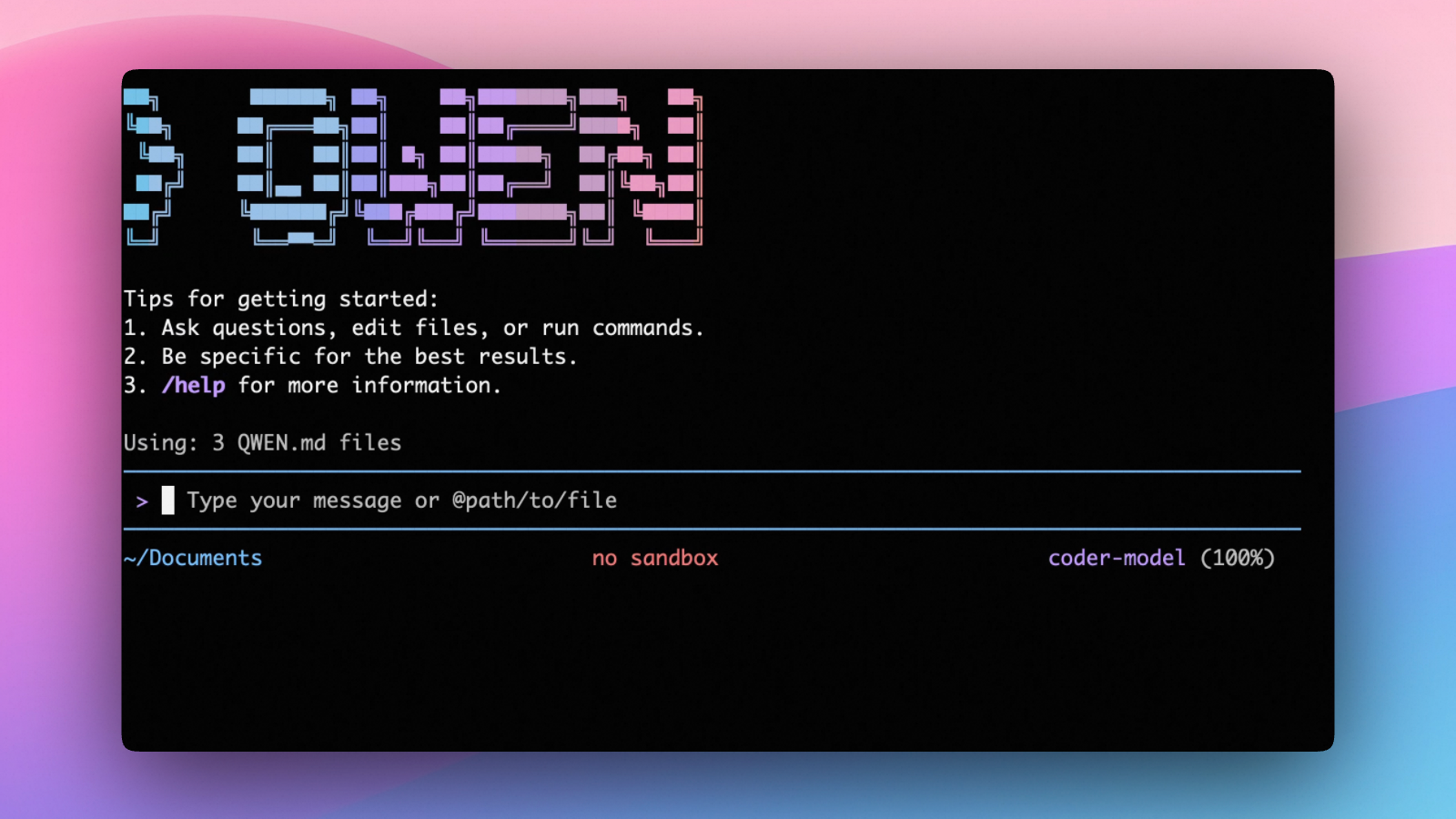
Installation
Quick Install (Recommended)
Linux / macOS
curl -fsSL https://qwen-code-assets.oss-cn-hangzhou.aliyuncs.com/installation/install-qwen-standalone.sh | bash
Windows
irm https://qwen-code-assets.oss-cn-hangzhou.aliyuncs.com/installation/install-qwen-standalone.ps1 | iex
> Note: It's recommended to restart your terminal after installation to ensure environment variables take effect.
Manual Installation
Prerequisites
Make sure you have Node.js 22 or later installed. Download it from nodejs.org.
NPM
npm install -g @qwen-code/qwen-code@latest
Homebrew (macOS, Linux)
brew install qwen-code
Quick Start
# Start Qwen Code (interactive)
qwen

# Then, in the session:
/help
/auth
On first use, you'll be prompted to sign in. You can run /auth anytime to switch authentication methods.
Example prompts:
What does this project do?
Explain the codebase structure.
Help me refactor this function.
Generate unit tests for this module.
Click to watch a demo video
Your browser does not support the video tag.
🦞 Use Qwen Code for Coding Tasks in Claw
Copy the prompt below and paste it into your agent:
Use Qwen Code as a coding agent. First, fetch and read this skill reference:
https://raw.githubusercontent.com/QwenLM/qwen-code/refs/heads/main/.qwen/skills/qwen-code-claw/SKILL.md
Then follow the instructions inside to install, authenticate, and use Qwen Code via acpx for all coding tasks.
Authentication
Qwen Code supports the following authentication methods:
- API Key (recommended): use an API key from Alibaba Cloud Model Studio (Beijing / intl) or any supported provider (OpenAI, Anthropic, Google GenAI, and other compatible endpoints).
- Coding Plan: subscribe to the Alibaba Cloud Coding Plan (Beijing / intl) for a fixed monthly fee with higher quotas.
> ⚠️ Qwen OAuth was discontinued on April 15, 2026. If you were previously using Qwen OAuth, please switch to one of the methods above. Run qwen and then /auth to reconfigure.
API Key (recommended)
Use an API key to connect to Alibaba Cloud Model Studio or any supported provider. Supports multiple protocols:
- OpenAI-compatible: Alibaba Cloud ModelStudio, ModelScope, OpenAI, OpenRouter, and other OpenAI-compatible providers
- Anthropic: Claude models
- Google GenAI: Gemini models
The recommended way to configure models and providers is by editing ~/.qwen/settings.json (create it if it doesn't exist). This file lets you define all available models, API keys, and default settings in one place.
##### Quick Setup in 3 Steps
Step 1: Create or edit ~/.qwen/settings.json
Here is a complete example:
{
"modelProviders": {
"openai": [
{
"id": "qwen3.6-plus",
"name": "qwen3.6-plus",
"baseUrl": "https://dashscope.aliyuncs.com/compatible-mode/v1",
"description": "Qwen3-Coder via Dashscope",
"envKey": "DASHSCOPE_API_KEY"
}
]
},
"env": {
"DASHSCOPE_API_KEY": "sk-xxxxxxxxxxxxx"
},
"security": {
"auth": {
"selectedType": "openai"
}
},
"model": {
"name": "qwen3.6-plus"
}
}
Step 2: Understand each field
| Field | What it does | | ---------------------------- | ------------------------------------------------------------------------------------------------------------------------------------- | | modelProviders | Declares which models are available and how to connect to them. Keys like openai, anthropic, gemini represent the API protocol. | | modelProviders[].id | The model ID sent to the API (e.g. qwen3.6-plus, gpt-4o). | | modelProviders[].envKey | The name of the environment variable that holds your API key. | | modelProviders[].baseUrl | The API endpoint URL (required for non-default endpoints). | | env | A fallback place to store API keys (lowest priority; prefer .env files or export for sensitive keys). | | security.auth.selectedType | The protocol to use on startup (openai, anthropic, gemini, vertex-ai). | | model.name | The default...
Excerpt shown — open the source for the full document.
Notability
notability 9.0/10High-stars code release from Qwen