The Perfect Productivity Match Financial Services And Genai
Captured source
source ↗North Mini Code. Cohere's first model for developers.
Jun 28, 2024
6 minutes read
The perfect productivity match: Financial services and GenAI
Knowledge work and customer service are foundational to the financial sector — and prime targets for LLM solutions.
While generative AI (GenAI) is reinventing how work gets done across industries, financial services (FS) is poised to reap the greatest productivity gains. According to Accenture, banks could see an impressive 30% boost in productivity, topping the more than 20 industries evaluated.
The reason for this is straightforward: the strengths of large language models (LLMs) align perfectly with both a top differentiator among competing banks — customer service — and a function that sits at the heart of the industry: knowledge work.
An intensely competitive environment has historically motivated financial services to adopt technologies earlier than many other industries, tech sector aside. With LLMs, all indications are that FS will again stand at the forefront of innovation.
McKinsey’s latest State of AI survey shows 41% of respondents from the industry investing anywhere from 6% to 20% of digital budgets in GenAI, behind only the tech sector (and on par with energy). A steady cadence of press releases from top FS firms touting their GenAI pilots, along with what we’re seeing in our work, corroborates the high interest.
The same McKinsey research, however, shows FS lagging in adoption and ahead of only the healthcare sector to date. From our conversations, this likely stems from concerns about the security risks associated with LLMs and mirrors the cautious approach taken in the early days of the cloud.
To help more FS firms tap into GenAI use cases, we’ll share how first movers are increasing knowledge worker efficiency and improving customer service, as well as address concerns for which mitigations exist.
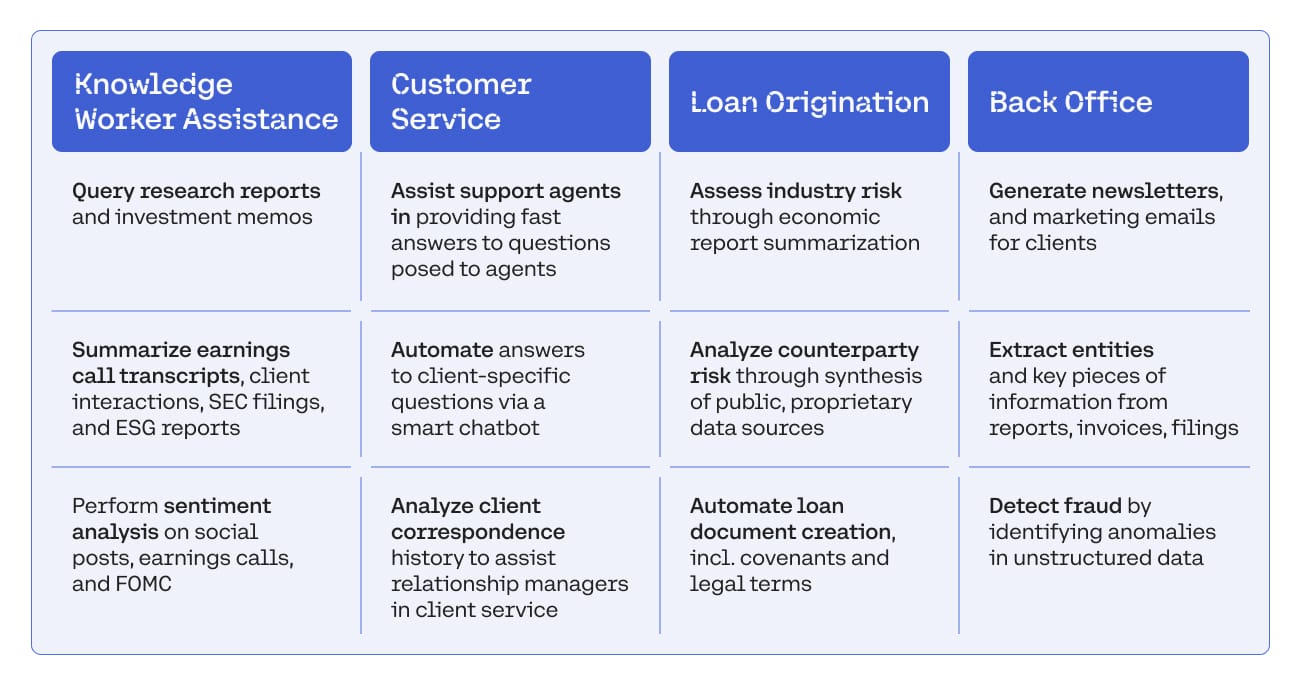Financial Service GenAI Use Cases
Making Knowledge Work More Efficient
Knowledge work is at the core of financial services. Investment bankers, financial planners, credit analysts, wealth advisors, equity analysts, risk managers — the list of industry roles that deal with vast amounts of information daily could fill the rest of this article. LLM applications can support them, both in finding information and analyzing it.
##### Faster Knowledge Search and Synthesis
These workers spend significant chunks of their days sifting through and extracting insights from troves of financial data, product specs, procedural documentation, and spreadsheets. Numerous studies have quantified the substantial amount of time workers spend hunting for information, with estimates ranging from 2 hours to 3.6 hours per day. The search, retrieval, and summarization capabilities of LLMs offer a significant source of time savings.
Homing in on one role, wealth advisors must monitor capital markets closely to manage risks and help clients make wise investment choices. While traditional machine learning models have enabled institutions to amass vast amounts of data, advisors still must sift through a myriad of documents — from regulatory filings to economic reports — to find the _right_ data.
AI knowledge assistants are changing this by distilling the latest financial statements and market analysis into concise summaries within seconds, and then answering follow-up questions to provide sources, clarifications, comparisons, and contextualization.
One financial technology company, whose customers include banks and asset managers, built a GenAI solution that enables advisors to quickly find information-rich documents, like 10K filings, and analyze them. Advisors can, for instance, ask for a company’s gross margin and then ask what other information in the report — perhaps in the MD&A or notes — might have driven it to be unusually high or low. Or they can ask about a competitor’s position in the market based on statements in various documents, such as investment analyst notes, account filings, and earnings transcripts.
The solution is built on a retrieval-augmented generation (RAG) architecture that combines Cohere’s suite of models: Command R, Embed, and Rerank. Embeddings ensure that the application extracts the information that best reflects the query’s context and how it relates to other information in the source documentation. Rerank improves the accuracy of search results to ensure that they’re matched with the advisor’s intent. And Command R+ can generate relevant responses and document summaries with source citations that ensure that the information delivered is verifiable and trustworthy.
##### Improving Data Analysis
LLM solutions can do more than just find knowledge — they can also help analyze it. Enterprises can automate financial, operational, and tabular data analysis by leveraging LLMs to examine various factors and generate reports. Equipping an LLM with a Python console, for example, enables organizations to start analyzing spreadsheets and financial data automatically.
Financial AI assistants are also capable of executing sophisticated prompts that can scan across documents, extract common information, and organize it in a standardized format that makes it easier to spot trends. In one case, the managing partners of an investment firm use Command R+ as part of a solution that helps them assess performance across their...
Excerpt shown — open the source for the full document.
Notability
notability 3.0/10Routine corporate blog post, no model release or traction.